VC1
Torrified pellets — production through shipment
End-to-end process flow across all sixteen production stages, from feedstock intake through torrefaction, pelletising, storage and outbound shipment.
Phase 1 · Feasibility design · Viiision × Suenco, BV
This site is the delivery point for Phase 1 of the Green Grass Solutions MRV platform — the Feasibility Design contracted with Suenco, BV. It explains every deliverable, what "done" means for each one, and gives you access to the work itself.
Eight deliverables: the Azure foundation and security configuration, the data architecture, the API framework, role-based permissions and audit trail, the multi-language content delivery engine, the mobile-first optimisation layer, a mobile-ready chain-of-custody prototype, and the Phase 2 plan.
How to use this site
Prepared by Viiision for Suenco, BV & Green Grass Solutions
01 / Objectives
Phase 1 is the Feasibility Design: the architecture, security, data model and working proof that everything after it depends on — and a costed plan for building the full platform.
Stand up the Microsoft Azure environment, identity, secrets and network security that the MRV platform will run on — documented and signed off, not improvised later.
Design a single source of truth across carbon, labor and traceability for both value chains, so every figure can be traced back to where and when it was gathered.
An API framework and validation gate so external systems, file drops, sensors and future integrations can feed the ledger — and partners can export from it.
Role-based, language-detected delivery for five languages, optimised for a mobile-first, low-literacy field workforce on unreliable connectivity.
A working mobile prototype tracing chain of custody end to end — lot to shipment to receipt — in at least two languages.
A written Phase 2 scope, phased timeline and budget, grounded in the architecture this phase produces.
02 / Process flows
Each flow walks all sixteen production stages for a value chain and shows exactly what happens, who does it, what the system records, and what must be true before the stage can close.
VC1
End-to-end process flow across all sixteen production stages, from feedstock intake through torrefaction, pelletising, storage and outbound shipment.
VC2
End-to-end process flow across all sixteen production stages, from feedstock intake through pyrolysis, quenching, curing, bagging and outbound shipment.
What each of the sixteen stages sets out
What initiates each stage.
The actions people must take at each stage.
Data captured automatically by the system.
Data that still requires manual entry.
The database tables and systems each stage writes to.
Where the resulting information is viewed.
Decision diamonds showing the pass / fail criteria.
03 / Working example
Two components demonstrate the MRV Prototype: a working web platform you can sign in to, and the Excel model that holds the decision engines and business logic behind it. The MRV Prototype is demonstrated through two components: the GGS MRV Prototype web platform, and the Excel MRV model that shows the decision engines and business logic end to end. Each comes with a supplementing guide.


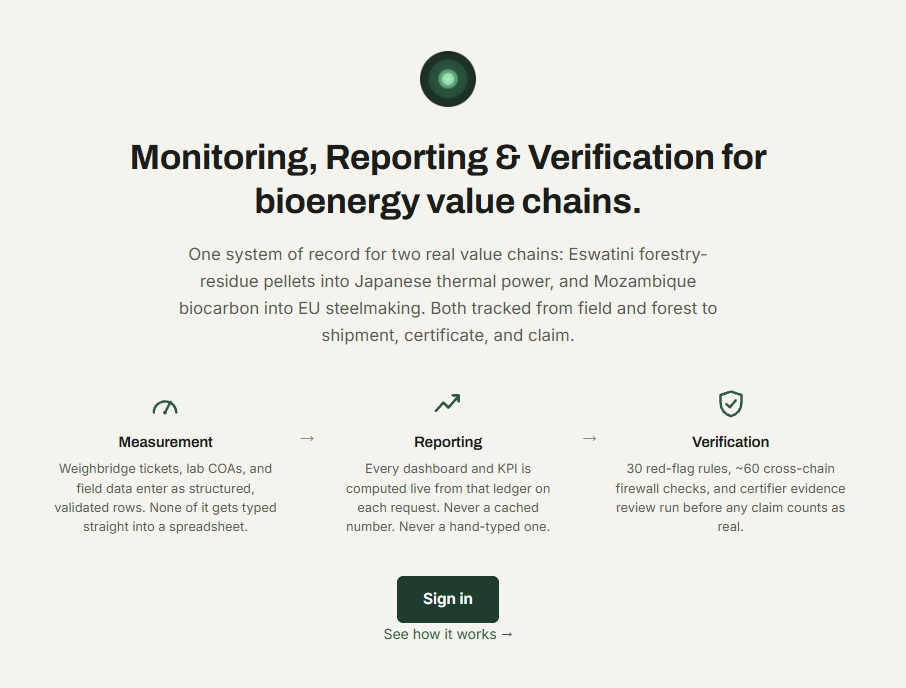
A working web version of the MRV system that incorporates the business logic and requirements detailed in the MRV Excel model — one system of record for both value chains, from field and forest to shipment, certificate, and claim.
How it is used: Sign in with the demo accounts below to experience the platform as each audience: measurement entering as validated records, live dashboards and KPIs, and the verification checks that run before any claim counts.
Demo accounts
Sign in as each audience to see exactly what they can see and do. Password for every account: ggsmrv-demo-2026
| Username | Audience | Access |
|---|---|---|
| admin | System Administrator | Full read/write |
| mrv_ops | Internal MRV / Compliance Operations | Full read/write |
| certifier | Verification Body | Compliance read/write, evidence |
| investor | Investor | Read-only KPIs and ESG |
| offtaker_japan | Offtaker, Japan Thermal Power (VC1) | Own chain only |
| offtaker_steel | Offtaker, Netherlands Steel BV (VC2) | Own chain only |
Accompanying document
A guided walkthrough of the MRV web app, screen by screen, for each audience.
How it is used: Follow it alongside the demo accounts to see how measurement, reporting, and verification work in the platform.

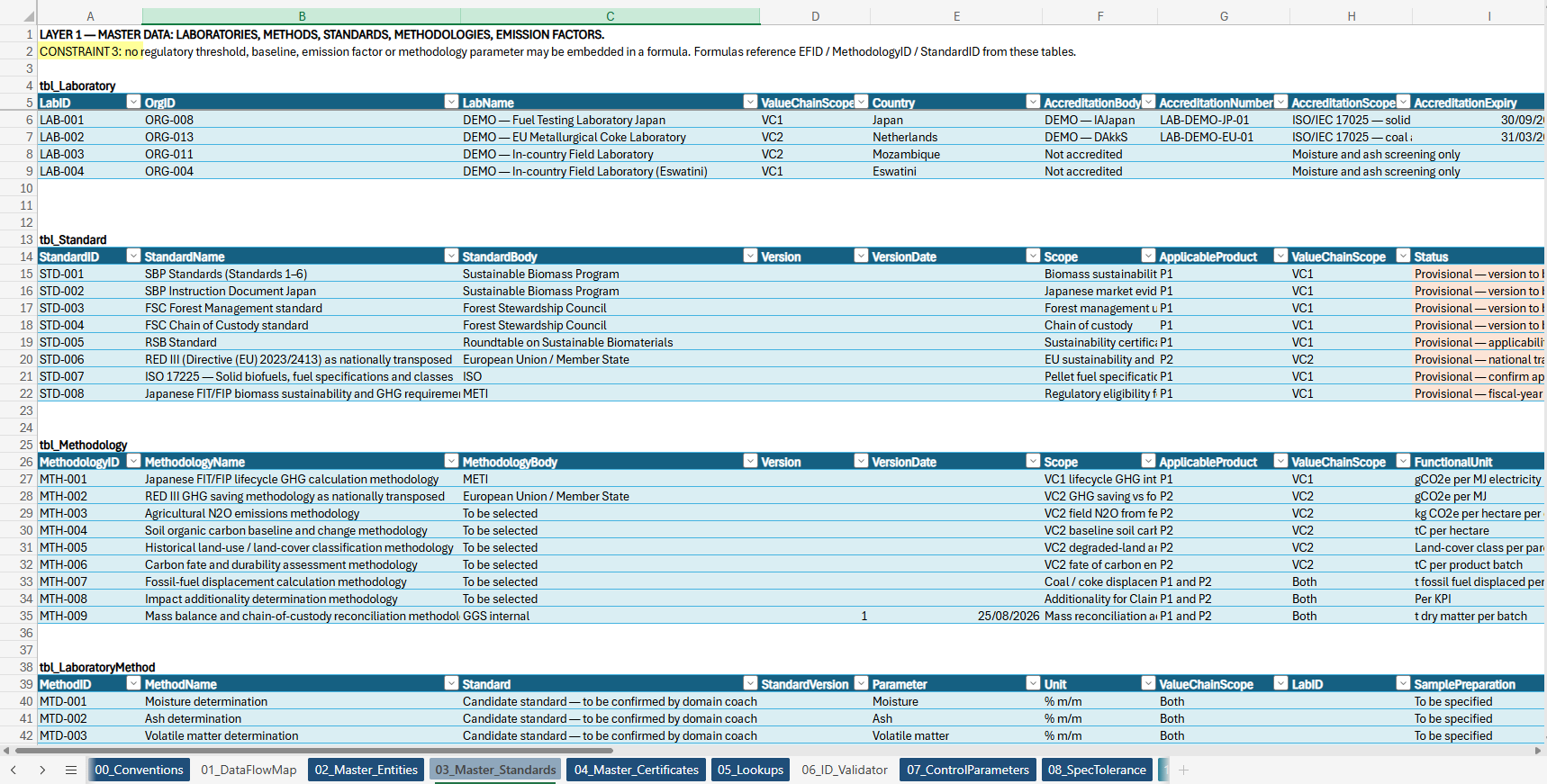
A full working model of the MRV system in Excel — the ledgers, the decision engines, and the business logic running on sample data, so the behaviour of the platform can be seen before it is coded.
How it is used: Use it to walk a real lot through the system and confirm the rules: the gate criteria, the calculations, and the reports they produce. Corrections you make here are corrections to the web platform's logic.
Accompanying document
A step-by-step guide to the working example: what each sheet is for, how records are entered, and how a result is read.
How it is used: Use it alongside the model so anyone at GGS can review the system without a walkthrough from us, and as the starting point for the training material used when the web platform goes live.
04 / Mobile prototype
The mobile experience field and plant teams will use: chain-of-custody reporting designed for phones, low bandwidth, and multiple languages.
Additional
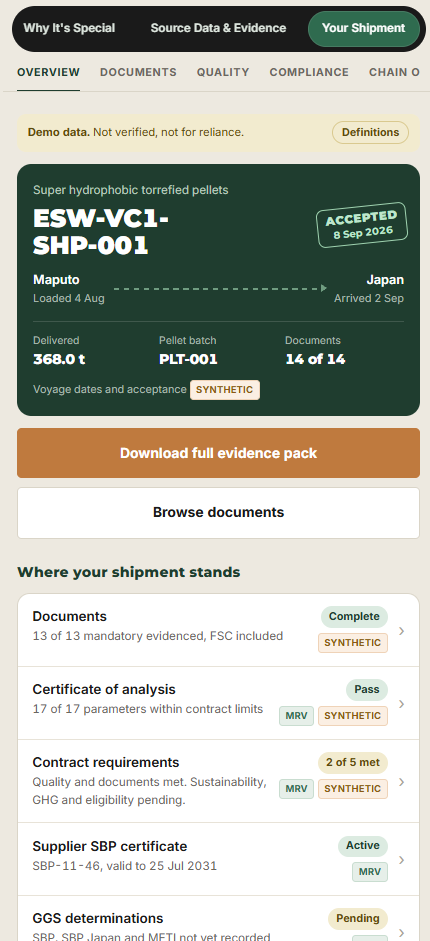
A mobile-ready prototype showing how the MRV system works in the hands of field and plant teams — low-bandwidth, multi-language, and tracing each lot through shipment to receipt.
Demonstrates Deliverable 1.7 in practice.

Documents in this deliverable
A working mobile prototype demonstrating chain-of-custody reports end to end (lot → shipment → receipt) in more than one language, built for low-bandwidth field conditions.
How it is used: Open it on a phone to experience the platform as a field user would: capturing records, switching language, and following a lot's lineage through to receipt.
05 / Vendors
Some evidence the MRV system needs is best sourced from specialist vendors. We have set the standards they must meet, identified the viable options, and built the platform so the vendor list can evolve.

We have created standards every data vendor must meet: data quality, method transparency, API access, security, and cost.
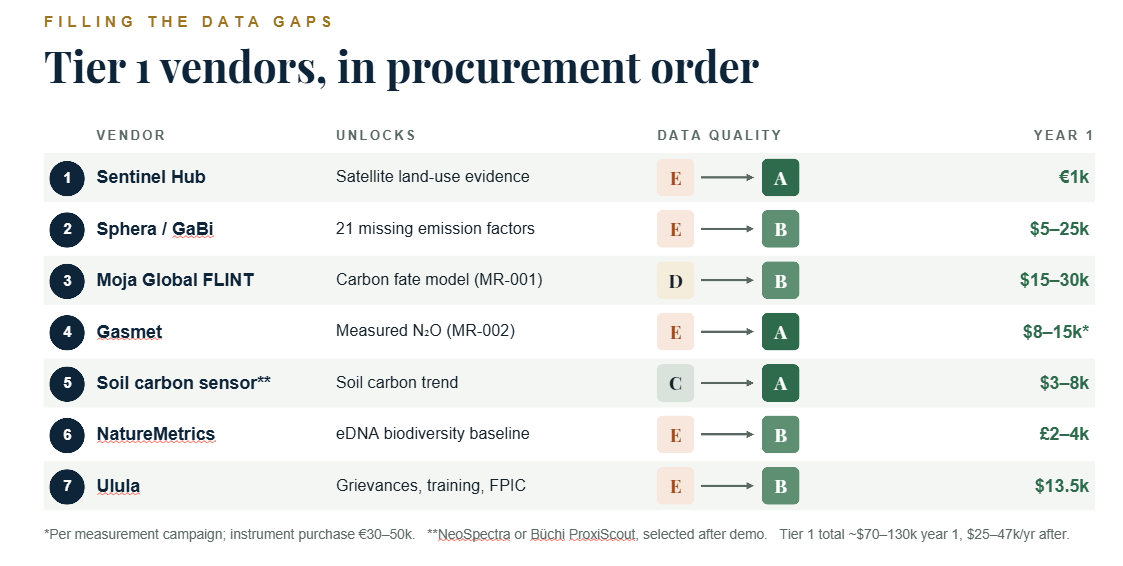
Vendors that fill each data gap have been identified and ranked in procurement order, showing what each unlocks and how it lifts data quality.
The platform is built so vendors can be added, swapped, or retired without rebuilding the system as needs and markets change.
We will provide ongoing services: vetting new vendors, maintaining API connections, monitoring data feeds, and alerting you to any problems.
06 / Deliverables
Each card states the deliverable, what completing it means, and links to the work. The graphics shown are placeholders standing in for the real artefact previews.
1.1
Provision the Azure landing zone, Microsoft Entra ID identity provider, Key Vault for secrets, baseline RBAC role definitions, and network security configuration for the MRV platform environment. Documented and signed off by GGS.
Documents in this deliverable
The provisioning record and plain-language product guide for the Microsoft environment: tenant and landing-zone setup, identity, secrets management, licensing, and what each service does for GGS.
How it is used: Use it to sign off the environment as delivered, to brief anyone joining the programme on how the platform is put together, and as the reference IT follows when new users, environments, or services are added.
The architecture specification for the technology stack and the field data collection platform — the components chosen, how they connect, and the security and hosting decisions behind them.
How it is used: Use it as the technical baseline for Phase 2 build: developers work from it, and it is the document to review if you want to challenge or change an architecture decision before construction starts.
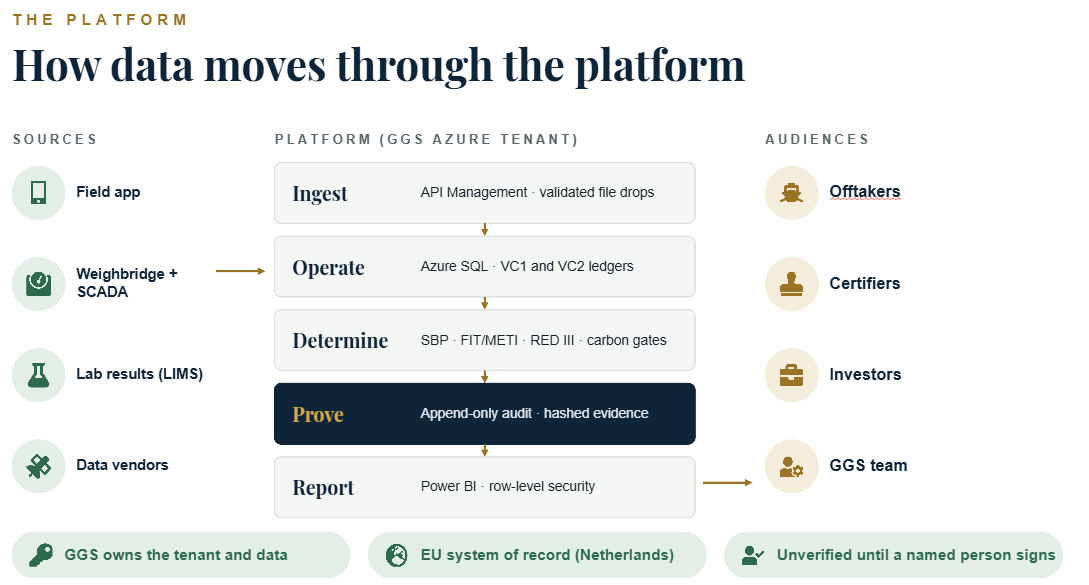
A one-page visual of the same architecture: every Azure service in the platform and the paths data takes between them.
How it is used: Use it in board, investor, and auditor conversations where the whole platform has to be explained on one slide, and as the orientation picture for new technical staff.
1.2
Schema/ERD design across carbon, labor, and traceability domains for VC1 and VC2. Covers all seven data-model layers (master data, VC1/VC2 physical ledgers, commercial & impact, compliance/certification, GHG & carbon accounting, evidence/audit/QA, dashboards & reporting) with universal fields and row-level security by ValueChainID.
Documents in this deliverable
The complete data dictionary: every table, every field, its type and meaning, the relationships between records, and the rules that keep VC1 and VC2 data separate.
How it is used: Use it to confirm that the system captures what GGS actually measures in the field and the plant. Any missing measurement, unit, or code list should be raised against this document during the review window — it is the definition the Phase 2 build works from.
A single-page diagram of the seven data-model layers, from master data through the VC1/VC2 physical ledgers, commercial and impact data, compliance and certification, GHG accounting, evidence and audit, up to dashboards and reporting.
How it is used: Use it as the shared map of the system: it shows where any given piece of data lives, which layer a new field belongs in, and how information flows upward from the field record to a certifier-ready report.
1.3
Build the API framework (Azure API Management + Azure Functions) that lets external systems and file drops push data into GGS MRV ledgers and lets the platform export data out, with schema validation gating what reaches the operational ledger.
Documents in this deliverable
A single-page diagram of the seven data-model layers, from master data through the VC1/VC2 physical ledgers, commercial and impact data, compliance and certification, GHG accounting, evidence and audit, up to dashboards and reporting.
How it is used: Use it as the shared map of the system: it shows where any given piece of data lives, which layer a new field belongs in, and how information flows upward from the field record to a certifier-ready report.
1.4
Define and enforce the five audiences (Investors, Offtakers, Certifiers/auditors/regulators, Internal MRV/compliance ops, GGS leadership) at the platform layer via Azure RBAC/row-level security. Every ledger write produces an append-only audit trail entry with full provenance. ValueChainID enforced as the cross-contamination control between VC1 and VC2.
Documents in this deliverable
A worked analysis of the five audiences: what each group needs from the platform, what they are allowed to see, the reports they receive, and the permissions that follow from that.
How it is used: Use it to check the access model against how GGS really works — who inside the business, and which investor, offtaker, or certifier, should see which data. Your edits here become the permission rules configured in Phase 2.
1.5
Role-based, language-detected content delivery with no manual toggling. Supports five target languages (Portuguese, Shangan/Tsonga, English, Japanese, Arabic). PoC demo in at least two languages.
1.6
Low-bandwidth, mobile-first layer for a low-literacy field workforce. Aggressive caching strategy with a video-first, image/audio-fallback media strategy demonstrated on simulated field connectivity.
1.7
A working mobile demo showing a chain-of-custody report tracing lineage end to end (lot → shipment → receipt) for VC1 or VC2, delivered in at least two languages with the mobile optimization and content delivery engine applied.
Documents in this deliverable
A working prototype you can open on a phone: it follows a single lot from field through shipment to receipt, in more than one language, on a low-bandwidth mobile layout.
How it is used: Use it to test the field experience yourself and with your own people — is the flow understandable, is the language right, is anything missing from the custody record before it is built for real.
1.8
Written Phase 2 scope document covering full field & plant data collection, dashboards, certification-ready reports, external interfaces (financial, drone, sensor), export APIs, QR-code worker experience, and multilingual onboarding. Includes phased timeline, budget, and roles.
Documents in this deliverable
The costed Phase 2 budget, broken down by workstream and role, with the assumptions behind each line visible.
How it is used: Use it for the Phase 2 investment decision and to adjust scope: trimming or adding a workstream shows its cost effect immediately, so the conversation stays about value rather than a single headline number.
The phased build schedule: each workstream, its sequence and duration, dependencies, and the points where GGS input or sign-off is required.
How it is used: Use it to line the build up against your own milestones — harvest seasons, certification audits, offtake and investor commitments — and to agree a realistic start date for Phase 2.
07 / Everything in one folder
Every document, diagram, schema export, configuration record and demo asset produced in Phase 1 sits in a single shared folder, organised by deliverable number. Nothing is held back — if it was produced in Phase 1, it is in there.
Folder structure
08 / The next two weeks
The purpose of the coming two weeks is to revise these deliverables against your insight. You know this operation, these sites and these off-takers better than any document can — your corrections make the architecture right before anything gets built on top of it.
Work through the deliverables and mark anything that does not match how GGS actually operates. Detail and disagreement are both welcome.
We walk the architecture, the data model and the prototype with your team, capture the questions live, and agree what changes.
We revise the deliverables against your insight and reissue them here, with the folder updated in step.
With Phase 1 settled, the Phase 2 scope, timeline and budget are ready to move on whenever you are.
Send comments however suits you — annotated documents, an email, or a call. Every piece of feedback lands in the revision, and anything we cannot resolve in two weeks is written into the Phase 2 plan rather than quietly dropped.
Thank you
Thank you for trusting us with this work.
We care deeply about what Green Grass Solutions is building — restoring degraded land, creating real work for the people around it, and proving every tonne of it with data — and it has been a genuine privilege to design the system that carries that proof.
We are excited to keep going. When you are ready, Phase 2 turns this design into the operating platform: full field and plant data collection, dashboards, certification-ready reporting, integrations, and the multilingual worker experience.
Andrea Sorensen · Founder & CEO, Viiision · andrea@viiision.com